
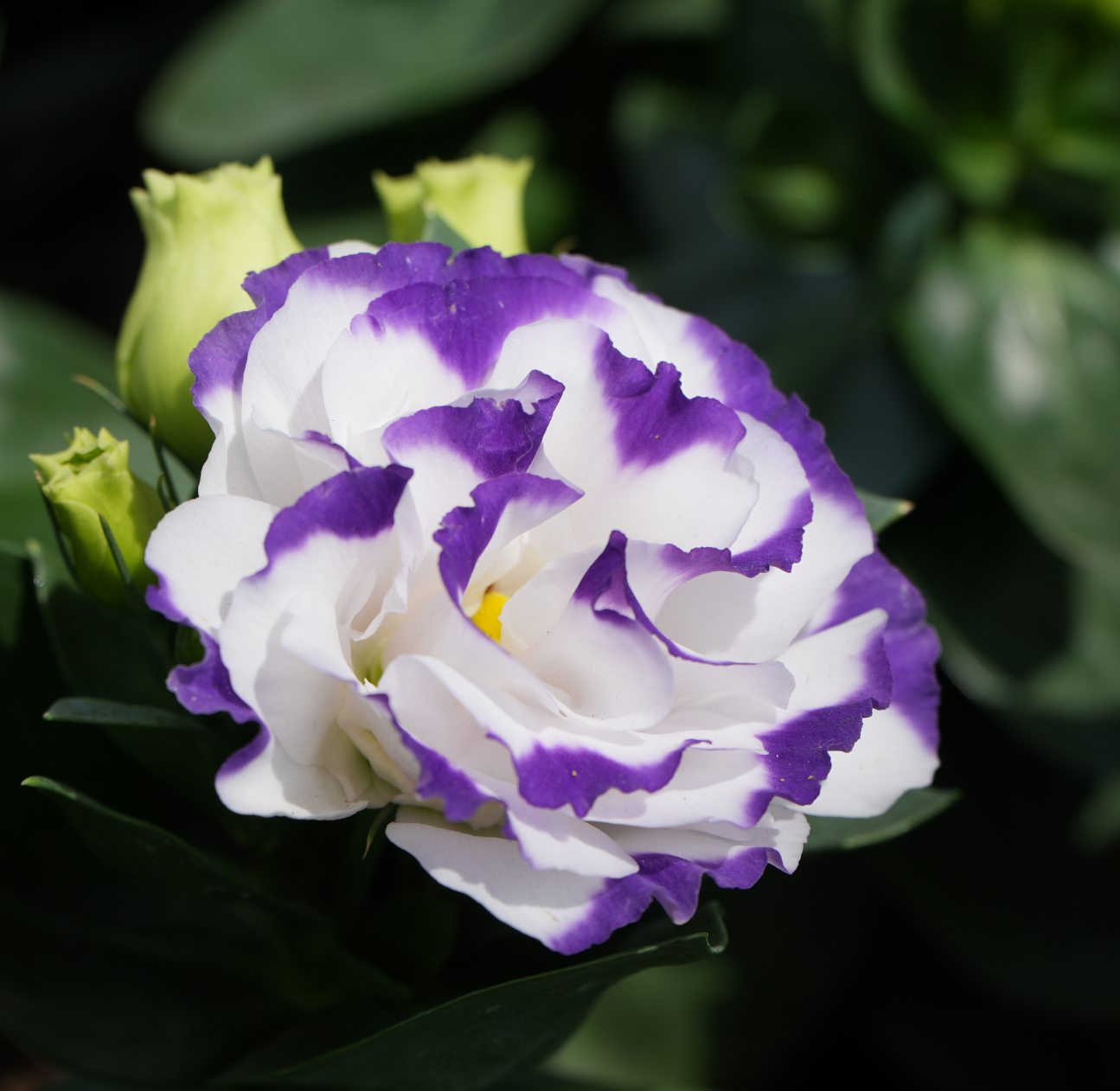
Today, we are discussing seed collection of one of the most beautiful Texas wildflowers, Texas Bluebells. These gorgeous flowers euphorically bloom in the height of Texas summer, effortlessly gorgeous, and incredibly unfamiliar to many…except for in name. Bluebells. If you talk to just about any Texan, they will know and love Bluebell icecream, A Texas original! As Texan as Whataburger! Bluebell ice cream once called Brenham Creamery Company (named for Brenham, TX where the creamery was founded in 1907) is rumored to have changed it’s name to Blue Bell Creameries after these stunning wildflowers. We offer seeds for these and other native Texas species at our Etsy shop, here.

The gorgeous Eustoma exaltatum spp. russellianum as it is currently known, is undergoing a taxon change. Once known as Eustoma grandiflorum (this specific epithet refers to the large blooms produced by this plant), current discussions are headed towards the botanical name of Eustoma russellium, with the potential for listing a subspecies. Texas bluebells have suffered for their beauty. The showy yet somehow rather unknown blooms are often spotted road-side, picked, and taken home to admire in a romantic wildflower bouquet. This happens so frequently that it has affected their ability to produce seed, dramatically reducing their current range. Seed capsules are borne of the showy blooms, maturing slowly on the plant before splitting open and spilling thousands of tiny seeds. Another issue facing many native plant species in remnant prairies and private lands is the threat of development. Texas is one of the fastest growing states in the nation, and now more than ever, our native prairie species are feeling the pressure.

Part of the reason we don’t see this flower in cultivation frequently is because of it’s very tiny seeds. These seeds are smaller than finely ground pepper, and have a reputation of being hard to work with and difficult to germinate. Eustoma is also short lived perennial, living for around 3-8 years. This combination of difficulty of propagating and short lifespan make this beautiful flower a rarity at plant nurseries. Here at Hambone’s Mercantile, we are working to get this pretty flower into more gardens and pocket prairies across Texas by selling them through our nursery, and helping people grow them from seed, the superior ethical option to attempting to transplant wild specimens (Please, don’t dig established wildflowers! Try to collect seeds or purchase plants grown in cultivation! Let’s keep wild places as wild as possible!).

The first notable action in doing our part to preserve, cultivate, and expand this flower’s range back to it’s full glory, is to collect seed ethically, and at the correct time. We have been working with Eustoma for quite some time, and have done a lot of experimenting. When collecting wild seed, it’s important to have landowner permission, and take good note on plant locations. Equally important is being certain of your species ID. Resources like iNaturalist https://www.inaturalist.org can generally get it in the ballpark, but getting comfortable utilizing a reputable dichotomous key like “Illustrated Flora of North Central Texas” (lovingly referred to as “Shinners”) will result in a greater degree of accuracy.
Shinners is the book we used in university, and let me tell you, it’s heavy. Scientifically, and physically (no, really. My college room mate and I weighed it…it’s 6lbs 11oz). There are others for other regions of Texas, but as we are located in the Cross Timbers region, in the DFW area, this is the one we recommend for here. Not to worry, if accurately collecting wild seed is not for you, we got you covered. Just get in touch for seeds or plants (as available).

Once seed donor plants are located and accurately identified, recognizing when they are ready to harvest is the next step. If working with a private land owner, we have found they are quite accommodating, even if their land management practices aren’t focused on preservation of wildflowers. This can be a struggle if we are talking about public areas or lands that are about to be developed. Then, it feels like a race against an unknown deadline for when all these beautiful flowers will be mowed down or bulldozed over. In these cases, knowing the earliest seeds can be harvested and still be viable is good knowledge to have.
For Texas Bluebells we’ve found that about the time the seed capsule is plump, popping out of the papery remnants of the flower petals, and just beginning to loose it’s sheen, there’s viable seeds in there. Lots of them. Of course, waiting until the capsule segments begin to yellow is ideal.

The next thing to remember is to be ethical about harvest. We look for mature plants with plenty of blooms, and plenty of mature seed capsules. We utilize small shears to snip mature seed capsules off of plants, close to the base. Small sheers are really handy here. Texas Bluebells exude a yellowy sticky latex, which can build up on skin and make harvest difficult in the field. We never remove all of the mature capsules, taking just a few from each plant. Remember that each capsule contains thousands of seeds, and in a large colony, harvest adds up quickly!

After harvest, we like to remove excess plant material to help the seed capsules dry out faster. The capsules will exude the same sticky yellow latex they did at harvest, so surgical gloves may be helpful here. We also use a flat bottomed glass dish to dry the seed capsules out in. The seeds are so very small that any sort of material at the bottom of the dish can hinder seed collection if the capsules begin to open in the dish. Move the seed capsules around every few days (this process takes a LONG time) to keep them from getting stuck to the dish, and to help air flow.
When the seed capsules become a chocolate brown color, the seams will start to pull away, and the seeds are ready for harvest. I use a white ceramic dish and craft knife to pry the seams of the capsule apart a bit. If the capsule is still soft, or sticky, it’s not ready, and should be returned to the glass dish for further aging.
Once I have the seams opened a bit, the capsule goes into a 45ml falcon (brand) tube. These are for scientific purposes, but can be purchased online. I shake vigorously to release the tiny seeds, then gently role the tube (held parallel to the table) to get the capsule remnants to the opening, and remove them. Sometimes, I break the capsule up and stick it in a second tube and shake again to get the last few seeds that I can. I don’t have any mature seed capsules at the moment, so I used some green ones for this visual.

After the seeds are collected, they stay in the scientific vial with the collection location and year. It’s incredible to me that such a very tiny seed could grow to produce such brilliant blooms!


Make a one-time donation
Make a monthly donation
Make a yearly donation
Choose an amount
Or enter a custom amount
Your contribution is appreciated.
Your contribution is appreciated.
Your contribution is appreciated.



Leave a Reply