Here at Hambone’s Mercantile, we have been keeping chickens far longer than we have been creating products for our customers. Chickens are one of the easiest steps towards becoming self-sufficient, and the breed(s) you choose is an important consideration, but varies widely based on your idea of self-sufficient. There are many ways to keep chickens, and none of them are necessarily wrong.

Some people like buying meat chicks every year, and some people like keeping a handful of egg laying hens in their back yards. In our case, the basics of a self-sustaining flock for us looks like keeping enough hens to keep us and our customers in eggs, and enough roosters to keep us in chicks and subsequently pullets, hens, and new roosters. We’ve also focused on selectively breeding desirable traits into our flock. We look for birds of large size, good temperament, and roosters that crow infrequently, at low volumes, and are respectful to hens and humans alike. There are several reasons we’ve gone this route. The biggest reason is we mainly rely on our flock for eggs, and though we do eat chicken sometimes, we don’t feel like meat birds are particularly sustainable since their breeding consists of proprietary crosses, and they don’t breed true, even if you go through all the work it takes to get them to reproductive age. They require high-protein feed, and lots of it. They don’t forage well, and are known to be lazy couch potato birds that aren’t particular about being clean. Some people like the speed and convenience, and knowledge of the background of the food that goes on their table though.

If you like the idea of meat birds, but not the traditional super fast growing broilers, there are other options like freedom rangers, which are said to gain weight fast and forage well. But, since our main focus is eggs, we haven’t done any work with meat breeds. So, we focused on breeds that would add egg color variety for our customers, and from those, we selected birds with gregarious, affectionate personalities (did you know that traits like personality are heritable like physical characteristics?). We added in BBS (Blue, Black, Splash) English Orpingtons for their beauty and their friendly disposition, and Swedish flower hens for their purported ability to lay through shorter days. Production reds were added for their early maturity and egg laying. Old English Game Hens were added for their broodiness and fierce mothering abilities. Each breed was selected for a trait we wanted to see overall in our flock.

We found that the production reds while very inquisitive and sweet, and impressively early laying age, were not very street smart and had poor situational awareness. We lost every one of these five hens to predators before we even got a chance to hatch any of their eggs. The Swedish flowers also started laying impressively early, and were very predator savvy, even to the point of being a bit flighty for our taste. We did get a few Swedish flower crosses out of them, but the pure Swedish flowers are no longer in our flock. They have rather large combs, and the rooster in particular had a very difficult time over winter. He required nightly application of coconut oil to his comb, and still ended up getting a touch of frostbite (note that we do not put supplemental heat in the coop. The mixture of bedding and chicken behavior is a recipe for a heat lamp catching fire, and we want to ensure that our chickens are acclimated to cold conditions in case we loose power which, is becoming a more real possibility every winter with our power grid…). The Swedish flowers with their impressive combs were the only ones that struggled with this over winter, and that is too much fiddly husbandry for our lifestyle. The Swedish flower crosses we have this year have much smaller, neater combs, like the BBS English Orpingtons they were crossed with. They also took on the early maturity of the Swedish flower, maturing months earlier than our very slow to mature English Orpingtons. They are also gorgeous, and taller than a five gallon bucket. We are very happy with them. Hopefully, they will fare better this winter than their parent stock.

A few notes on stock quality: We feel where your stock originates from is important. When we started out, we started with hatchery stock. They were perfectly lovely birds, but as we have developed our flock, we’ve seen the differences in personalities and traits of hatchery birds compared to birds from breeders. The later adheres to breed standard far better than hatcheries, some of which produce birds that are barely passable as the breed they were sold as. These birds can be physically small, or they may not meet breed appearance standards, or they may have off personalities. They are just cranked out at high volume for low prices. These birds still produce great eggs, and they generally live long, healthy lives, but if you go this route, don’t expect the birds you end up with to match breed appearance and trait descriptions. If you are looking to go the direction we did, adding specific personalities and traits to your flock, you are likely better off looking for individual breeders. Even if you don’t intend to raise pure-bred stock.

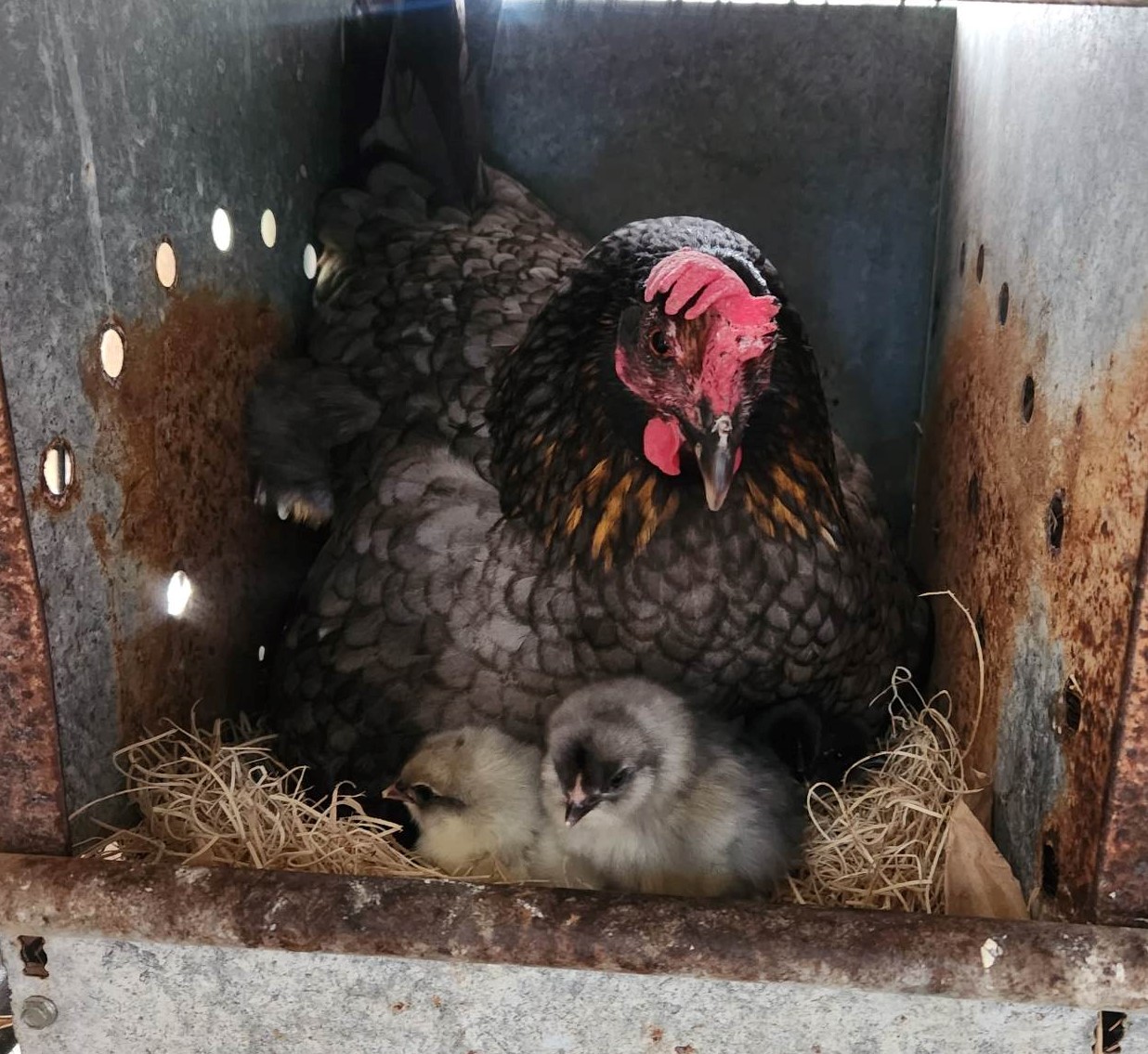
Broodiness is one trait we have found to be a bit challenging. One problem with modern chicken breeding is that we are not reliant on the hen to do the work. We can produce large numbers of chicks from fertile eggs utilizing incubators. This means we no longer have to select for hens that will raise their own babies, because we can do a decent job at it, and produce many many chicks at one time. At Hambone’s Mercantile, we feel it is important to have a flock that CAN raise it’s own chicks. Both breeders and hatcheries rely heavily on incubators. That means the birds they produce may or may not ever go broody. Our solution was to choose a breed that is closer to wild-type than many of our modern birds. The game hen. Lots of people asked us why we didn’t just use silkies. They’re known for going broody too. Well, for one, we are in Texas. There are lots of predators, and lots of weather fluctuations. The feather mutation gene that gives silkies their cotton candy appearance also means their feathers do not insulate them like traditional feathers. Remember the part where we don’t give supplemental heat? We want robust birds that need minimal interference from us. Another tick in the box against adding silkies to our flock is their small size, and delicate skulls. Many silkies in the US have what is called a vaulted skull. Images of them are fascinating, but also add a point of weakness to the bird’s body. Additionally, with their fluffy feathers covering their eyes, they cannot see threats coming. Especially in a mixed flock of very large birds. Often when chickens get into it with each other, they peck tops of heads. It can get pretty brutal, and even though our flock is very docile, things happen, and silkies are simply too delicate to go up against that. The last strike against silkies for us is their predisposition to vitamin deficiency. Silkies are more prone to wry neck. A condition in which they don’t absorb (or intake) appropriate levels of vitamins. The biggest indicator being the chicken will begin to hold it’s head at very weird angles. The treatment is providing a liquid vitamin supplement, but for us, self-sufficient means our animals have to be pretty sturdy as well. So, we went with the very robust, small, but mighty little game hen. We started with a single hen, given to me as a gift, with her clutch of eggs, for my birthday years ago. Probably one of my more memorable gifts. She was SO flighty, and SO aware of her surroundings, and so so fierce in defending her clutch against ANYTHING. She gave us about 8 game hens from that clutch. We chose the most docile of the group, keeping only two. Those two hens produced game crosses, and from those crosses, we again selected the most docile of the group.

We continued crossing these hens with our most docile roosters, and eventually ended up with two amazing game crosses (Lady Gray, and Scarlett). These two ladies are still obviously flightier than our heftier girls, but they are the most phenomenal mothers. Lady Gray is the most dependable, easiest mother to work with. Her very first clutch was well-hidden, on the wrong side of the fence, under the frame of a 1929 ford roadster in the front corner of our acreage. It took us a week to find her. I was so distraught, thinking this savvy, feisty little hen met her end somewhere in the woods. We found her diligently sitting on her eggs by complete accident one day…on over a dozen eggs…she had been sneaking away for weeks to create this secret cache, and none of the other hens had followed her and added to her nest. Clever girl.

Three days before her approximate hatch date, we saw her moping around the yard, muttering to herself. She had lost every egg to some predator. I scooped up my sad little hen, and on a whim, decided I would try to give her eggs that had been incubated a similar length of time…they were under my meanest broody. A pure game hen we added a few years before. She had spurs that put the roosters to shame, and she was always out for blood (at this time, she was really our only broody, but she was just too over the top for us). I risked my life, and grabbed a couple of eggs for Gray. Not every chicken will allow you to move her…sometimes, broodies will abruptly stop brooding if you move them, but I couldn’t let her risk brooding in the same spot again. So, I took a chance, and I moved her to a safe quite nest box. She took to those eggs so fast, quietly talking to them over the next two days. One hatched. She never let that baby more than 2 feet from her, and from that point on, she never tried to go off on her own to nest. She’s still independent, but she seems to have an understanding that we are here to help and support her. Like clockwork, she lays 12-20 eggs, then goes broody. She raises whatever eggs we give her, where ever we move her to. She is gentle and wonderful. She looks like a game, but she barely acts like one. These ladies have gone a long way to adding broodiness to our flock, and this year, we have a good selection of pullets showing interest in brooding.

We are just as selective with our roosters. When I started keeping chickens many years ago, my view of roosters was colored by all the horror stories of monstrous roosters that beat up and pulled wing feathers out of hens. My first rooster was an accidental male from a hatchery order of sexed females. He was mean. I got rid of him quickly. He was my first encounter with a rooster. And he made me understand why people don’t keep them, or have horror stories about them, or ward them off with brooms and poles…I was determined never to keep roosters again.
Then, that game hen I told you about? My first ever game hen? A gift for my birthday? She disappeared one day. She was gone, and I was surprised. She was smart. She was cunning. How did something nab her? Well, nothing nabbed her. She went of to have a secret clutch. Which, should have resulted in a bunch of unfertilized eggs…except we had purchased some sex link roosters for the freezer. They were so mean we culled them early. But apparently, not early enough. She came back with a single steel blue chick. We caught her up and confined them, and lo and behold, that single chick was a boy. Of course. So, I decided that when he got mean, I would just put him in the freezer too. Turns out, that day never came.

Being raised by a game hen, he was never cuddly, but he was always respectful. To the humans, and to the hens he looked after. He was also gorgeous. Steel blue with a red saddle, and a proud comb. We don’t know exactly what he was mixed with, because the sexlink roosters we got were from a local lady. She had many breeds, and we didn’t really ask about the mix she used for sexlinked birds (these are birds that you can tell male from female by their feather pattern at hatch. Certain color crosses produce sexlinked [their feather pattern is linked to their sex] birds-that’s a discussion for another day). He was the first “nice” rooster I encountered. A game mix with a fierce stance, and a respectful attitude. We named him Smokey, and he was the foundation of our whole flock. From each resulting generation, we selected the nicest most docile rooster.
We found that it takes about a year for a baby rooster to mature enough to tell what kind of personality he will have. When they start reaching sexual maturity, they get confused about what they are supposed to be doing, and they are trying to figure out how to be a rooster, and they are frustrated because if they don’t act right, the older ladies in the flock will put them in their place. Again, and again. During this period, we try to give our young roosters grace. They get allowances for making dumb choices. If they maliciously draw blood, they go in the freezer, but all the other randy, dumb stuff they choose to do, they get the space to do that. After the year is up, and their personality begins to mature, we decide if they make the cut or not. In the past three years, we have never had a mean rooster produced from our flock. Our roosters babysit their chicks, and bring tidbits to mom and babies. If a rooster is picking on new chicks, and not helping keep the other girls in line so babies don’t get injured, he is doing the opposite of his job.
If you’re new to roosters, also keep in mind that every spring, they get a flush of hormones, and may act dumb and randy again for a while, but again, never accept them breaking skin or drawing blood. There are SO many nice roosters out there. There’s no reason to accept cruddy behavior from a less than gentlemanly rooster. I know that now, because I see our nice roosters every day in our flock, and I have watched them for generations. One last note on roosters: if you do end up with a mean rooster, please don’t think that rehoming him is the solution. There is absolutely no reason to make a mean rooster someone else’s problem because it feels bad to put him in the freezer. Either be straight forward with people as to why you are getting rid of him, and be okay with them putting him in THEIR freezer, or just put him in your own freezer.
Mindfully selecting individuals we want to contribute to our next generation has driven our flock in really lovely directions. We have English Orpingtons, and crosses that look like English Orpingtons, but that are larger, and mature fasters. Our roosters crow just a handful of times in a day, and at a volume that is surprisingly low for their large size. They are respectful of humans, and are great lookouts for the flock they protect. When we select which roosters stay, we choose docile roosters that are kind to the hens, and don’t challenge the humans. Now that the appearance of our birds is pretty predictable, we focus a bit more on personality. It takes time, but selective breeding for traits you want produces results. We have big, fluffy birds with neat tidy combs, and friendly personalities. The roosters almost never crow, and when they do, it’s relatively quite. The next step for our flock may be working on their maturity rate just a little bit. We don’t want to tweak it too much just yet though! One component of becoming more self-sufficient is being cognizant of the season in which things must be done.

Right now, it takes our roosters around a year to kind of mentally mature. A bit longer for their bodies to physically mature, so when our hens go broody in early spring, we have a good idea of which roosters will be staying by early winter. Mainly because we have become very accustomed to what to expect from them personality-wise. If we could accelerate their maturity just a little, early spring chicks will result in early winter freezer birds. Not that we cannot put our roosters in the freezer a bit earlier than we would like body-weight-wise, but some days I think it would be nicer to have a bit more meat on those bones when I pull chicken out of the freezer. I don’t mind the somewhat slow maturity, because that gives me an opportunity to observe my birds carefully, and have an idea of what they will contribute to the flock later. So for the most part, their slow maturity works just fine for us. In Texas, by early winter, it’s not unbearably cold out, and more importantly, it’s not unbearably hot. We generally process our chickens outside, next to the fire pit. In cooler weather not only is the warm firepit welcome, we don’t have to worry about spoilage like we would in the heat (another reason why I am not really interested in meat birds-they can’t go much past 6-10 weeks before they basically must be processed-with this longer time frame, I am in no rush to get them processed, which adds to that feel of sustainability). Our birds will never have the meat development of broilers, but they have a lovely depth of flavor I don’t think you get with broilers. The process is also very unhurried, which I appreciate.

We simply scald and pluck, process, and chill. The chill time varies by batch. We place ours in a well-insulated cooler, on a wire rack to keep them from getting water logged. When chilling and aging, it is important to keep everything below 45 f to prevent spoilage. The biggest mistake most people make when processing their chickens for the first time is not allowing enough time for the aging process. Chickens that spend their lives foraging and free-ranging use their muscles way more than chickens that spend eight weeks eating as much feed as they are given. Those muscles worked, and they need time to relax. The actual process is enzymatic. When I taught freshman biology at university, this concept seemed to confuse some of my students, but I will try to provide a short synopsis here. Essentially, you have an enzyme (the key), and a substrate (the lock). there is a set amount of keys to unlock the substrate with. In this case, the enzyme is working on the muscle fibers to relax them. Enzymes typically are optimally active around body temperature, but we cannot leave the chickens at body temperature, as spoilage bacteria are just as active then. In colder temperatures, enzymes work slower, but they don’t quit. So, the easiest way to check to see if your chickens are ready to be packaged and stored, is checking joint flexibility. Once the enzymes have done their work, the chicken will have gone into rigor, and back out of it, and limbered up quite a bit. Knee joints should be very flexible, as should wing joints and hip joints. The hip joints tend to get flexible first.
Once the chicken is nice and loose at all it’s joints (you will need to change out ice and drain water throughout the process to prevent spoilage-a thermometer in the cooler may help you ensure you keep everything below 45 degrees) it’s time to package and store. We use a LEM vacuum sealer, and sometimes we pressure can. Chicken can be pressure canned bone-in. Follow the guidelines set forth by the National Center for Home Food Preservation, Ball/Bernardin, or Extension Office services, as meats are low-acid, and require specific processes for safety reasons. You can do bone-in (which I haven’t tried) for a shorter processing time.
Some of these options seemed very intimidating and uncomfortable to me when I first started my self-sufficient journey. I am an animal lover in the purest sense. I feel deeply, and I understand how uncomfortable facing some of these topics can be, but I also understand that we selectively bred these animals to be our companions, but also to nourish us in ways few other things can. The connectedness we have with these animals is human participation in its most pure form. There are very few modern things that connect us back to what sustains us than the intimate task of caring for and being nourished by the same hand. I encourage you to step out of your comfort zone and see just how much control we still have over our interactions with the environment and with each other. The path towards simplicity starts with saying no to corporate giants making profits off our emotions. We need to look past how things make us feel, and evaluate how our actions impact our environment. If we work towards vertical integration in our private lives, we cut down on unnecessary packaging and complicated, convoluted products that make a monetary play at our emotions with the illusion of being better versions of ourselves. shrinking the loop of necessity to sustain ourselves is revolutionary in this world.



Leave a Reply